Rated excellent on Google Reviews

Sharing picture books with young children
The journey of language begins in the womb, and sharing picture books is a vital investment in your child's future. From building deep emotional bonds to boosting cognitive development, this guide offers practical tips to make story time a joyful, lifelong adventure for the whole family.
Carole Anne McKissock


It is fascinating to know that even in the womb, a baby in around the last 10 weeks of development can respond to sounds. Evidence from research indicates that unborn babies react to their mother’s voice and can react to it after birth. It is also believed that exposure to the mother’s voice helps to lay the foundation for the development of language, introducing rhythm and melody in the sounds spoken.


Sharing books is a vital investment in your child’s lifelong development
The benefits and joys of sharing books with young children is well documented, but sometimes it can seem complex and overwhelming.
Here are my top suggestions based on both my own experience, and from research. However, remember to do what feels comfortable for you and the child! Children benefit from the input of a variety of others in childhood, so get family and friends to contribute. Older siblings are also a great reading resource so get them involved!


Start early
The research is out there making a case for reading to unborn babies. There is also much research to encourage parents to read with their baby from birth. As they develop, as well as hearing and listening to the words that are being spoken, they will be seeing the shapes of the pictures on the pages.
High contrast, and black and white pictures are recommended for newborns as they have limited colour perception, although they gradually develop their ability to see colours and focus on detail. Books with pictures containing faces are particularly attractive to babies and you can use your own face to stimulate responses from them!
Even at this early stage, reading with babies helps them to visually interact with books, which not only helps stimulate cognitive development, but develops an early understanding that pictures tell stories. As they develop, they begin to make the connection between the words and pictures and understand the meaning of ‘a story’.


Make it calm, comfortable and cosy
Whether it’s pre-nap, bedtime, or just as an interval to more active play, finding a cosy, comfortable space where you can share books is so important. Including the child’s favourite cuddly toy also adds to the ambience. If you’re on the move, maybe a soft banket or rug will suffice!


Allow the child to choose
As they grow, children can be encouraged to help choose the books to be shared with them. This gives them an important sense of ownership in the reading process. You can even build the excitement and anticipation by helping the child to chose books for later in the day, perhaps placing them somewhere special in readiness e.g. propped up on the sofa, in a book basket, on their pillow or bedroom chair.
Allow the child to explore the book at their own pace. They may initially just want to turn the pages to look at the pictures. Encourage their curiosity. Don’t worry if they want you to re-read the same books. Repetition helps them to learn and anticipate familiar words and phrases; it also develops their memory skills.
As they grow and become familiar with their favourite stories, encourage them to read them aloud in their own words. This encourages language development and is an important pre-reading skill. A doll, stuffed toy, and even the dog, can make an excellent audience!


Engage your acting skills
Read the story in a way that will engage the child. Use expression and intonation, letting your voice rise and fall to suit the story. Create voices for the characters and use sound effects to build atmosphere, anticipation, and excitement. You’re sure to get lots of giggles from your captive audience!


Language and literacy development through simple involvement
Encourage the child to call out repeated words, phrases or rhymes in the story, all of which supports memory. Help them to adapt their voice - loud and booming giants, gentle whispers from the wind, a baby crying, a cow mooing, an engine roaring. The possibilities are endless, and so much fun! Ask them questions about the pictures and encourage them to tell you about the story. Encourage them to predict what might happen next. Develop their answers further by using a different word or re-phrasing and developing their response. “Naughty dog” might become, “Yes, the dog was very naughty for running away!”
Sharing stories and books also helps the child to begin to make connections between spoken and written language. Regular exposure to the written word, in a range of forms, will help them to recognise letters and the sounds they make.

Social and emotional development and the importance of play
Sharing stories is such a good way to contribute to the child’s social and emotional development. Through the story plot, the child learns to consider the viewpoint, feelings and actions of the characters and begins to relate them to their own lives. This development of empathy is important in helping children to develop an understanding of those around them and in developing positive relationships.
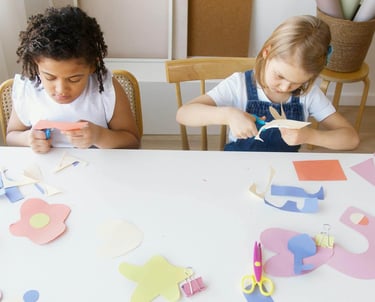
By providing the child with creative materials, the child then has further opportunities to engage in creative play. Drawing and painting, role play, and outdoor play will support the reading process and enable them to experiment and develop their cognitive and social and emotional skills. It’s good to have a box of scrap paper, pens, recycled bits and tape/glue. Bits of scrap fabric and old socks are also perfect for making puppets and collages. See my Fun activities to pair with book reading blog for suggestions on how to follow this up.


Developing physical co-ordination
As well as all of the above, sharing books benefits a child’s physical development. They develop hand-eye co-ordination through following the words and pictures on the pages; holding the book, turning pages and lifting flaps helps to develop their fine motor skills. They may seem clumsy at first but they will soon begin to develop good book handling skills with repeated exposure to them. Fetching books from a box or stacking them on a shelf contribute to their gross motor skills and with encouragement, they will learn to handle books with care and respect.
Conclusion
Picture books such as “Lamb in a Pram” are invaluable resources in child development. They not only entertain but also educate, inspire, and nurture young minds. As parents, carers and educators, it's essential to integrate these visual stories into the early learning journey of children.
We hope you have lots of fun!